Loading…
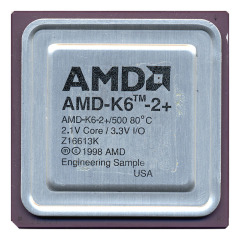
K6-2+
Launched in 2000The AMD K6-2+ is a late mobile-derived refinement of the K6-2 architecture introduced in 2000, designed primarily for low-power notebooks and embedded systems but later widely adopted by enthusiasts as a high-end upgrade for Super Socket 7 desktops. Built on a 0.18 µm process, it retains the core architecture of the K6-2, including superscalar execution, dynamic instruction handling, MMX, and 3DNow! support, but adds an on-die 128 KiB L2 cache running at full core speed, greatly reducing latency and improving real-world performance relative to earlier motherboard-cache-dependent K6 variants. It also benefits from lower voltage operation, better thermal characteristics, and improved clock efficiency, while preserving compatibility with Super Socket 7 platforms where BIOS support exists. Technically, the K6-2+ is best understood as the most refined and efficient member of the K6-2 lineage, bridging the gap between AMD’s classic Socket 7 era and its later Athlon generation.